
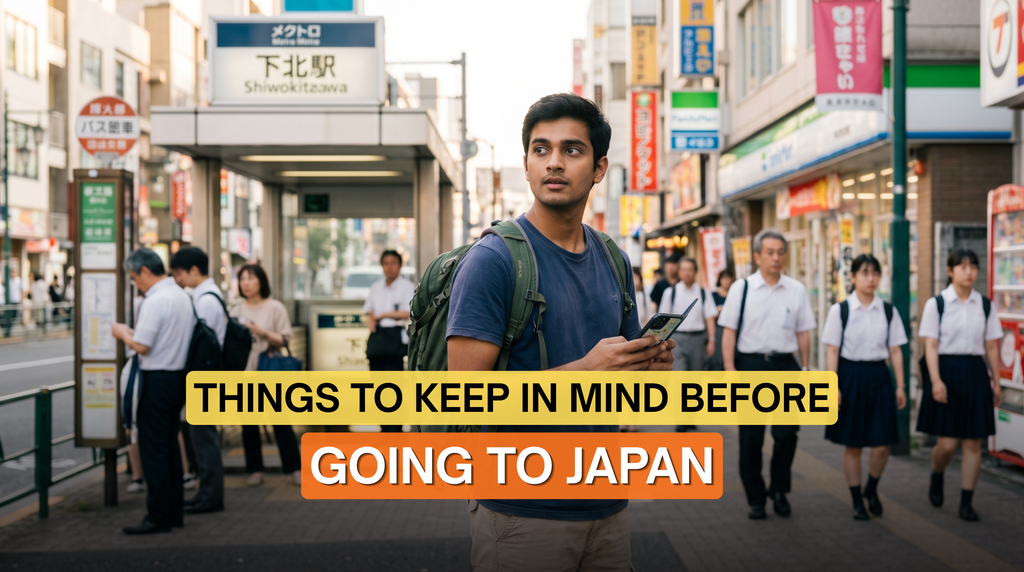
Things to Keep in Mind Before Going to Japan
Japan is unlike almost any other country you will visit. The trains arrive to the second. The streets are spotless despite having almost no trash cans. Many shops still do not accept cards. People stand in perfect lines without being told to.
None of this is complicated once you know what to expect. But if you land without any preparation, you might find yourself confused or accidentally rude without meaning to be. This guide will make sure that does not happen.
1. Carry Cash — Do Not Rely Only on Cards
Japan is still very much a cash-first country. Many small restaurants, local shops, shrines, and vending machines only accept yen. Do not assume your international card will work everywhere — it often will not.
Withdraw Japanese yen as soon as you land. ATMs at airports are reliable, and so are ATMs inside 7-Eleven stores across the country. Keep a mix of coins and bills with you at all times, because many small purchases and vending machines are coin-based.
2. Get a Suica or Pasmo Card
These are rechargeable IC cards you tap to enter and exit trains, subways, and buses all across Japan. They remove all the stress of figuring out ticket prices or standing at ticket machines every time you travel.
You can pick one up at any major train station, including at the airport. Load it with around 3,000 to 5,000 yen to start and top it up whenever needed. Many convenience stores and vending machines also accept Suica as a payment method, making it genuinely useful beyond just transport.
3. Understand the Train and Metro System
Japan's train network is massive but very logical once you get used to it. For getting around cities, your Suica card handles everything. For long-distance travel between cities like Tokyo, Kyoto, and Osaka, you will use the Shinkansen (bullet train), which requires a separate ticket or a Japan Rail Pass purchased before arriving in Japan.
Use Google Maps for navigation — it works brilliantly for Japanese trains, giving you platform numbers, transfer instructions, and exact timings. One important note: trains stop running around midnight in most cities. Plan your evenings accordingly or be prepared for an expensive taxi ride.
4. Be on Time — Punctuality Is Strict Here
In Japan, arriving on time means arriving a few minutes early. Punctuality is a basic form of respect, and it is taken seriously across the country. Japanese trains are so precise that a one-minute delay prompts an official public apology.
If you have a restaurant reservation or a tour, be there a little before the scheduled time. If you are running late, communicate ahead. Silence followed by a late arrival is what people here find genuinely disrespectful.
5. Follow Public Etiquette — Silence and Discipline Matter
On trains and in most public spaces, the expectation is quiet. People do not take calls loudly, do not play music on speaker, and generally keep their voices low. Eating on local city trains is frowned upon, though it is fine on long-distance trains.
When waiting for a train, join the queue where the doors will open. Let passengers exit before you enter. On escalators, stand on the left side and keep the right clear for those walking — except in Osaka, where it is the opposite. Watch what locals do and follow their lead.
6. Understand Trash Rules — There Are Almost No Dustbins
Japan's streets are remarkably clean, which makes the near-total absence of public trash cans all the more surprising. The reason is simple: people are expected to carry their trash with them until they find an appropriate bin.
Convenience stores have small bins near the exit for items purchased there. Vending machines usually have a can and bottle recycling bin beside them. For everything else, carry a small plastic bag in your daypack to hold your trash until you find the right place to dispose of it.
7. Get a SIM Card or Pocket WiFi
You need internet access in Japan, and you need to arrange it before you land. Google Maps, translation apps, train schedules, and your hotel booking confirmations all require a connection. Japan is not a country where navigating offline is easy.
At the airport, you can rent a pocket WiFi device or pick up a local data SIM. Both options are affordable and widely available. Also download Google Translate and enable its offline Japanese language pack before your trip. The camera translation feature — where you point your phone at Japanese text and it translates live — is genuinely essential for reading menus and signs.
8. Book Accommodation in Advance — Location Matters
Japan is one of the most visited countries in the world, and good accommodation fills up fast, especially during cherry blossom season in spring and autumn foliage season in November. Book at least two to three months ahead if you are traveling during these periods.
Where you stay matters as much as where you stay. Choose accommodation near a well-connected train station. A hotel that is close to a major station will save you significant time every single day. If budget allows, try to spend at least one night in a traditional ryokan — it is one of the most distinctly Japanese experiences you can have.
9. Carry Your Passport at All Times
Tourists in Japan are legally required to carry their passport with them. You will need it to check into hotels, claim tax-free shopping discounts, and purchase certain passes. A small travel wallet worn close to your body is the most practical way to carry it safely.
Japan has a generous tax refund program for tourists — you can reclaim the 10% consumption tax on eligible purchases at many shops, but only if you show your passport at the time of purchase. It is worth keeping it on you.
10. Learn to Use Convenience Stores
Japanese convenience stores, called conbini, are nothing like the ones back home. They are clean, well-organized, and stocked with genuinely good food — fresh onigiri, hot steamed buns, egg salad sandwiches, karaage chicken, and much more. Many travelers eat from konbini regularly, not just to save money but because the food is actually that good.
Beyond food, you can withdraw cash, print documents, pay bills, and pick up tickets — all at a convenience store. They are open 24 hours and are usually within a two-minute walk of wherever you are in any Japanese city. Get comfortable with them early.
11. Respect cultural differences
Japan has one of the richest, most layered cultures in the world — and some of its customs are genuinely unlike anything you'll encounter elsewhere. A little humility and curiosity go a long way. The simple act of observing before acting is considered respectful in itself.
At shrines and temples: bow before entering the main gate, use the water purification fountain (temizuya) before approaching the hall, and avoid pointing your camera directly at people in prayer. Tipping is not customary in Japan — in fact, it can sometimes cause confusion or even mild offence.
Final & Most Important Step Before You Go: Learn Basic Japanese
Everything else will make your trip smoother—but this one will change your experience completely.
English is not widely used everywhere in Japan, but even a small effort in Japanese is highly appreciated. A simple phrase can make interactions easier and more positive.
For example:
- Sumimasen (excuse me)
- Arigatou gozaimasu (thank you)
- Kore wo kudasai (please give me this)
- Eki wa doko desu ka? (where is the station?)
- Eigo ga hanasemasu ka? (do you speak English?)
These alone can help you in most daily situations.
If you want to prepare properly before your trip, Yoisho Academy offers beginner-friendly Japanese courses designed to help you feel confident when you arrive in Japan.
🔗Enquiry form: https://yoisho.in/get-in-touch/
Final Thoughts
Japan rewards travelers who show up prepared. It is one of the most extraordinary countries in the world to visit — thoughtful, precise, generous, and deeply beautiful in ways that are hard to describe until you are there.
Carry your cash, tap your Suica card, stay quiet on the train, carry your trash, say itadakimasu before you eat, and learn a few words of Japanese. Do these things, and Japan will give you memories that stay with you for the rest of your life..
Ganbatte! (Good luck!)
Comments
0 Comments
Submit a Comment
Your email address will not be published. Required fields are marked *