
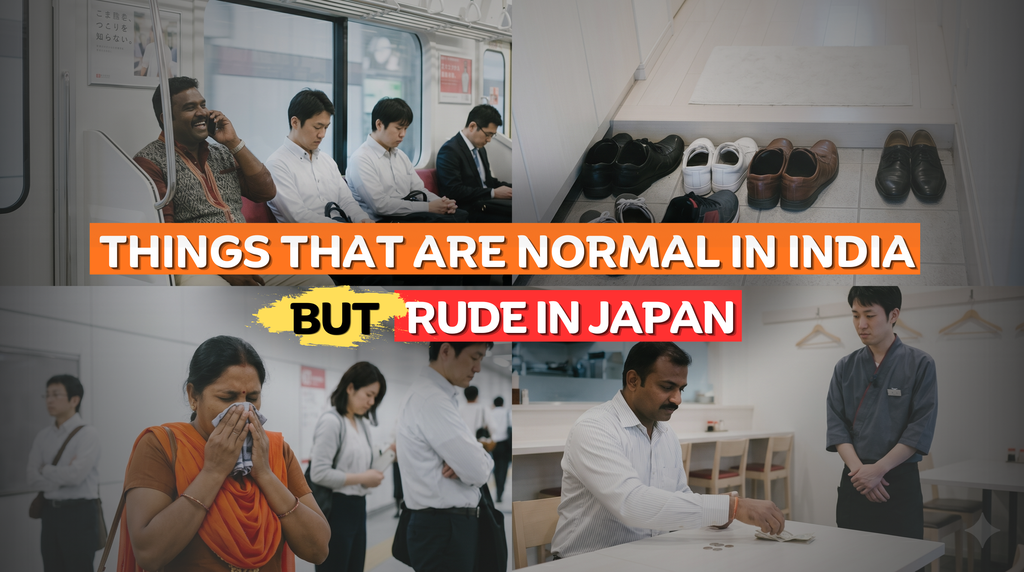
Things That Are Normal in India But Rude in Japan
(A Friendly Guide for First-Timers)
So you're going to Japan. Or maybe you're just curious about how different two countries can be, even though both have a billion-dollar love for food, festivals, and family. Either way — this blog is for you.
If you're an Indian visiting Japan for the first time, some of your everyday habits might accidentally come across as rude — and you won't even know why people are giving you that look.
1. Talking Loudly in Public
Back home in India, noise is everywhere & honestly, it feels alive. The chai wala shouting, neighbours chatting across balconies, the auto driver honking for no reason. It's just... normal.
In Japan, public spaces are very quiet. Like, surprisingly quiet. People on the metro, in malls, even at parks, they speak in low voices or not at all. Nobody is being unfriendly. That's just how they respect each other's space.
What to do: Just imagine you're in a library. Keep your voice low. If you're excited about something, save it for when you're back at your hotel room.
2. Eating While Walking
This one hurt me a little to write, because walking with a cone of bhutta or a plate of chaat is a whole Indian experience.
But in Japan, eating while walking (they call it "tabearuki") is considered bad manners. It's not about being strict, it's just about showing respect to the food and not making a mess for others.
What to do: Buy your snack, find a spot nearby, even standing next to the shop is fine. Finish it there, and then continue walking. Locals do this too, so you won't look weird.
3. Being "A Little Late" to Everything
In India, if someone says a function starts at 6 PM, everyone knows the actual start time is 7:30 PM. We even have a joke about it, "Indian Standard Time." No offence, but it's just our thing.
Japan is the complete opposite. If your meeting is at 2 PM, you should already be there at 1:45 PM. Being even 5 minutes late without informing someone is considered disrespectful, like you're saying your time matters more than theirs.
What to do: Leave early. If something comes up and you'll be late, send a quick message immediately. A simple "Sorry, I'll be 3 minutes late" goes a long way.
4. Talking on the Phone in Public Transport
The metro or bus in India is basically a free calling zone. People catch up with relatives, argue over plans, laugh loudly, kids run from here and there, it's a whole social experience.
Japanese trains are almost silent. People are on their phones, yes — but they're texting or scrolling, not talking. Making a phone call on a train is considered very rude there.
What to do: Keep your phone on silent mode. If you really have to take a call, wait for the next station, step out on the platform, and speak there.
5. Standing in a Queue (Or Not Quite)
Indian queues are more like... creative arrangements. Everyone stands close together, elbows slightly out, ready to defend their spot. Sometimes two lines become one. It's survival of the quickest.
In Japan, queues are taken seriously. People stand in a perfectly straight single line, with space between each person. If there are markings on the floor, everyone stands exactly there. And when the bus or train arrives, people wait for others to exit first before getting in.
What to do: Look for floor markings and stand on them. Give people space. And always, always let people exit before you enter.
6. Handing Over Money With One Hand
At any kirana store in India, you hand cash with one hand while checking your phone with the other. Nobody thinks anything of it.
In Japan, money is handled with both hands as a sign of respect. Most shops have a small tray at the counter where you're supposed to place your cash or card there, not hand it directly to the person. The cashier will also return your change using both hands and sometimes count it out loud.
What to do: Use the tray if there is one. If not, offer your card or cash with both hands. It takes one second and means a lot.
7. Showing Big Emotions in Public
Indians are expressive people. We cry at weddings, argue passionately about cricket, and laugh so hard the whole street hears us. It's warm, it's real.
Japan has a concept called "くうきをよむ" [ kuuki wo yomu] which roughly means "reading the air." The idea is that you sense the mood around you and don't disrupt it. Big displays of emotion whether anger, sadness, or even too much excitement are seen as making others uncomfortable.
What to do: Stay calm and neutral in public. Not cold just composed. Save the big emotions for private spaces. And if you find an izakaya (a Japanese pub), the rules get more relaxed there anyway!
8. Blowing Your Nose in Public
In India, blowing your nose with a handkerchief is just basic hygiene. Nobody bats an eye.
In Japan, doing this loudly in public is considered gross. It's actually more acceptable to sniffle quietly or wear a mask. And if you do need to blow your nose, use a disposable tissue, not a
cloth handkerchief. The idea of carrying a used hanky around in your pocket isn't considered hygienic there.
What to do: Step away from people, find a corner or a restroom, and use a tissue. Dispose of it right away.
9. Tipping at Restaurants
Okay, here's one that surprises most Indians. In India, leaving a tip is a kind gesture — it makes the waiter happy and you feel good about it.
In Japan, don't tip. Seriously, It can actually come across as offensive. The thinking there is that doing your job well is already expected, so offering extra money can feel like you're pitying the person or treating them like a beggar. Staff have even run after customers to return tips they thought were accidentally left behind.
What to do: Just pay the bill. Smile, say "Arigatou gozaimasu" (thank you very much), and that's genuinely enough.
10. Removing Shoes — But Actually Doing It Properly
In India, we do remove our shoes before entering homes and temples. So this part feels familiar. But in Japan, it goes a level further.
There are specific places called "genkan" (entryway) where you remove your shoes. And here's the part people miss — you should turn your shoes around so the toes point outward (toward the door), not inward. It's a small thing, but locals notice it.
Also, if slippers are provided inside the house, use them. And if you go into a room with tatami (woven mat flooring), take off even the slippers.
What to do: Always look for a step or a change in flooring — that's your signal to remove shoes. Turn them neatly. And never walk on tatami with slippers.
11. Throwing Trash Anywhere Handy
In India, finding a dustbin is sometimes a full adventure. And honestly, if you can't find one, the side of the road becomes the plan B for many people.
Here's the strange thing about Japan, there are almost no public dustbins on the streets. Yet the country is incredibly clean. How? Because people carry their trash with them until they find a proper bin, often at a convenience store or train station.
What to do: Keep a small bag with you for wrappers, tissues, or empty bottles. Don't leave trash anywhere, not on benches, not on the street, not even in random corners. It's not just manners, it's how the whole system works there.
So What's the Big Lesson Here?
Japan and India are different — but neither is wrong.
In India, we're loud, warm, and expressive. In Japan, they're calm, careful, and very considerate of the people around them.
When you understand why they do things a certain way, it stops feeling like rules and starts feeling like respect.
The quiet on the train = giving everyone mental peace. The perfect queue = trusting that no one will cheat. The two-handed money exchange = saying "I see you as a person."
You don't have to stop being Indian to be respectful in Japan. You just have to be a little more aware of the people around you. That's it.
Want to Learn Japanese Before Your Trip?
Knowing even a few words of Japanese makes your trip 10 times better. Saying "Sumimasen" (excuse me) at the right moment, reading a menu, or just smiling and saying "Arigatou" to a shopkeeper — these small things create real connections.
Yoisho Academy is an Indian Japanese language school made especially for Indian learners — beginners, students, working professionals, anyone curious about Japan. The courses are simple, structured, and taught in a way that actually makes sense for us.
👉 Click here to get in touch with Yoisho Academy
Ganbatte! (Good luck!)
Comments
0 Comments
Submit a Comment
Your email address will not be published. Required fields are marked *